
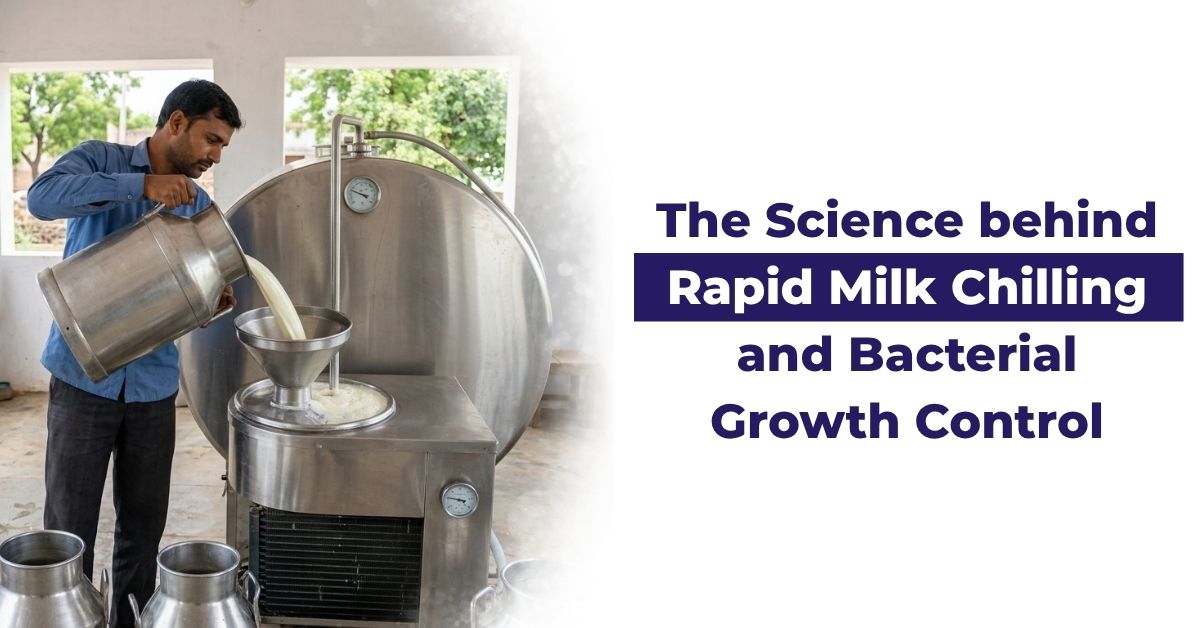
The Science behind Rapid Milk Chilling and Bacterial Growth Control
In the wee hours of the morning, when the country is still asleep, farmers wake up to milk their cows and sell it fresh. However, every litre of milk collected at the farm begins losing value the moment it leaves the cow, and it takes time to reach our doorstep because it passes through several stages of quality checks before being deemed fit for consumption. Even a brief delay in cooling can accelerate bacterial growth, impacting product quality, shelf life, and ultimately profitability. This is where rapid milk chilling becomes crucial.
The Science of Bacterial Growth in Milk
The Problem: Why Does Milk Spoil So Quickly?
When milk leaves the cow, it is around 37°C, which is close to room or body temperature. The nutrient-rich nature of raw milk, along with these ideal temperature conditions, promotes rapid bacterial growth.
The Impact
Warm temperatures create an ideal environment for bacterial growth. If the milk remains at elevated temperatures for extended periods, microbial populations can increase exponentially, affecting freshness, taste, and overall quality.
As soon as raw milk leaves the cow, it also becomes vulnerable to various sources of contamination that can compromise its quality. For example, if the cow’s udders aren’t clean, they can introduce harmful elements into the milk from the surrounding environment. Additionally, mastitis, which often goes unnoticed, can significantly impact the quality of the milk. But biological factors aren’t solely responsible for contamination. Agrochemicals, natural toxins in feed, or improper use of chemicals during processing can also impact the quality of milk.
Therefore, it is extremely important to ensure that dairies process and pasteurize raw milk properly before distributing for consumption. Proper pasteurization eliminates most of the pathogens that could negatively impact consumers’ health.
Why Rapid Milk Chilling is Critical
Milk is a highly perishable commodity that can see bacterial growth within an hour of production. However, because the dairy supply chain consists of multiple stages, it takes several hours for milk to reach the final consumer, giving it plenty of chances to spoil along the way.
The most effective way to preserve milk quality is to chill it to 4°C as quickly as possible. Instant chilling helps retain nutrients and curbs the exponential growth of bacteria.
One of the most effective techniques to check the quality of raw milk is the Methylene Blue Reduction Test, where a redox dye is added to a milk sample. This dye remains blue in oxygen-rich environments, and faster decolorization indicates higher bacterial population and poor milk quality. Generally, instantly chilled milk will show higher MBRT values, which means lesser bacterial load.
Therefore, farmers and dairies can avoid milk spoilage and ensure it meets quality standards by instantly chilling it.
Challenges in Maintaining Milk Temperature During Collection and Storage
Dairies collect milk from several farmers spread across multiple villages every single day. Sometimes, these collection drives last the entire day, covering various milk collection centres, before making it to the dairy. Hence, not only does the milk need to be instantly chilled and kept cold for a long time, but it is also important to have sufficient capacity in the collection apparatus to store all the milk.
To maintain milk quality across long collection cycles, dairies need a cooling solution that can rapidly chill milk, store it safely, and continue performing even when power availability is unpredictable.
Impact of Power Outages on Milk Quality
India ranks at the top in global milk production, at 247.87 million tonnes, with dairy being the largest agricultural product in the country. This achievement is particularly significant given that our vast network of farmers, spread across some of the remotest villages, come together to contribute milk that is collected, chilled, processed, and delivered to our doorstep.
However, with milestones come setbacks. Uninterrupted power is still scarce in several villages, and milk collection centres often have to rely on expensive diesel generators to keep operations running.
Power interruptions can compromise the cooling process, allowing milk temperatures to rise and creating favourable conditions for bacterial growth. Since maintaining milk at low temperatures is critical to preserving its quality, any disruption in cooling can increase the risk of spoilage and quality deterioration.
For dairies operating in such conditions, the challenge is not just rapid chilling, but maintaining that temperature consistently until the milk is processed.
How Prompt TSBMC Addresses These Challenges
One such solution is the Prompt Thermal Storage-based Bulk Milk Cooler (TSBMC), which combines rapid milk chilling with thermal energy storage to support uninterrupted cooling.
Unlike conventional bulk milk coolers that rely entirely on continuous electricity supply, the Prompt TSBMC incorporates thermal energy storage technology. This means that the system stores cooling energy when power is available to maintain the milk’s temperature during power fluctuations and outages.
This stored cooling capacity acts as a thermal reserve, helping keep milk at the required temperature even when the compressor is not actively running. By maintaining low temperatures during power interruptions, the system helps prevent the conditions that accelerate bacterial growth and compromise milk quality.
For dairies that need a reliable solution for chilling their milk without any interruptions, the Prompt TSBMC can harness power from multiple sources for the job, with its grid and solar compatibility.
Freshly collected milk is cooled to the desired temperature within two hours in the storage apparatus, giving dairies enough time before processing.
If milk collection centres already have a bulk milk cooler, equipment like the Prompt TSBMC can also be retrofitted. This is a step towards enhancing milk processing and reinforcing India’s global positioning as the largest milk producer.
Choosing the Right Rapid Milk Chiller
Since milk chilling is an integral part of the dairy supply chain, it is important to choose the right bulk milk cooler that is versatile enough to cater to various requirements. This will help farmers preserve the nutritional value of their fresh milk and slow down bacterial growth.
One of the parameters to keep in mind while choosing a bulk milk cooler for your operations is to understand your daily milk production. For instance, solutions like the Prompt TSBMC come in different variants suited to various capacities.
Another factor that dairy operators need to consider is energy efficiency. Electricity is a recurring expense, and every unit saved matters when the initial cost of procuring a BMC is already high.
Lastly, the BMC must be easy to maintain. Any equipment that handles milk risks leaving residue behind that could contaminate future batches. Therefore, systems with efficient cleaning mechanisms can play a significant role in maintaining the quality standards of the milk processed.
Power outages shouldn’t put your milk quality at risk.
Consult our experts to discover how Prompt TSBMC can help you maintain reliable milk chilling while reducing dependence on the grid.
FAQs
One should chill milk to approximately 4°C as quickly as possible after collection because lower temperatures slow bacterial activity.
By cooling milk soon after milking, dairies can slow bacterial growth, preserve freshness, and reduce spoilage losses across the supply chain.
While refrigeration does not completely stop bacterial growth, chilling milk to around 4°C significantly slows microbial activity.
By preserving the required temperature for longer periods, it reduces the risk of bacterial growth, minimizes spoilage, and helps ensure milk remains fresh until processing.
When selecting a bulk milk cooler, dairy operators should consider factors such as cooling performance, storage capacity, energy efficiency, ease of maintenance, power reliability, operating costs, and compatibility with future expansion requirements.
Rapid milk chilling helps preserve milk quality by slowing bacterial activity and reducing the risk of spoilage.
