
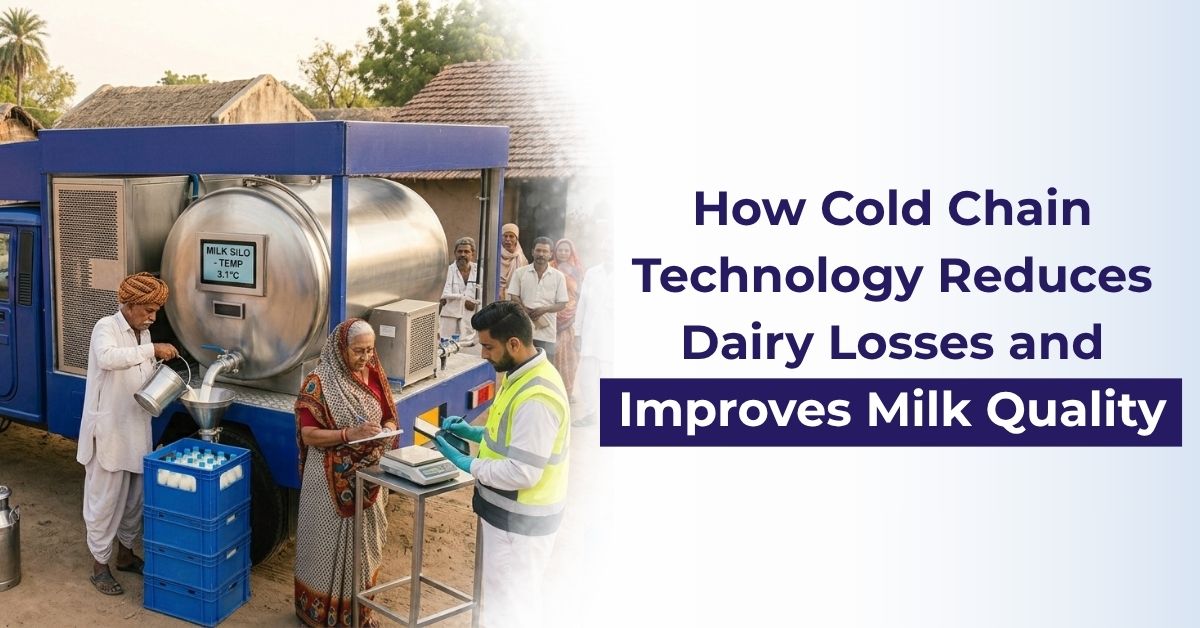
How Cold Chain Technology Reduces Dairy Losses and Improves Milk Quality
In the dairy industry, speed is of the essence.
Milk is a highly perishable commodity, and its quality deteriorates by the minute. Dairies therefore must establish a network that supports milk preservation at every step to ensure its quality is maintained until it reaches the processing plant. The most effective way to retain raw milk’s quality is to chill it instantly. That’s why dairies are focusing on establishing cold chains that keep the milk consistently chilled throughout its journey to the plant.
What is a Cold Chain?
Cold chain technology is a temperature-controlled supply chain, often uninterrupted, that ensures commodities travelling through it remain at a set temperature. For raw milk, it is important to chill it to 4°C within an hour of production to preserve its quality.
Maintaining this temperature is critical at every stage of transport and storage, from collection centres to consumers. Any breach in the cold chain could severely affect milk quality, increasing sourness and causing an unpleasant taste and odour.
Benefits of Cold Chain Technology in Preserving Milk Quality
Modern cold chain solutions help dairies maintain consistent temperatures from milk collection to processing.
Stopping Bacterial Growth: Cold temperatures stunt bacterial growth, which is crucial for preserving its quality.
Extending Shelf Life: Improved raw milk quality is known to have a longer shelf life even after pasteurisation.
Preserving Nutrients and Taste: When dairies retain milk quality, it positively affects taste and nutrition after processing.
Challenges in Cold Chain Management
Raw milk is susceptible to bacterial growth as soon as it leaves the cow. The more it remains at room temperature, the faster bacteria develop, leading to spoilage. This is why it is important to maintain a temperature of 4°C across the entire cold chain, which has its own challenges:
Unreliable Grids
In India, milk comes from several collection centres spread across numerous villages and districts. Not only does the milk take time to reach the processing plant, but it also comes from areas without a reliable grid power supply. This hampers the cold chain and increases the chances of milk spoilage along the way.
High Energy Costs
Many dairies rely on Bulk Milk Coolers (BMCs) for cold chain management to help preserve milk quality. However, BMCs are expensive to establish and maintain. They require a high upfront investment and consume a lot of energy, which drives up power costs.
Delayed Chilling
Even if dairies manage to establish a cold chain, milk quality could still take a hit if the chilling is delayed at any stage. Traditional cooling methods often involve gradual chilling over longer periods, increasing the risk of temperature fluctuations and rapid bacterial growth.
Traditional Chilling v/s Instant Chilling
| Parameter | Traditional Milk Cooling | Instant Milk Chiller |
|---|---|---|
|
Chilling Pattern |
Gradual cooling over a longer period |
Rapid cooling immediately after collection |
|
Exposure to Bacterial |
Higher due to delayed chilling |
Lower due to the quick drop in temperature |
|
Spoilage Risk |
Higher because of high bacterial exposure |
Lower due to low bacterial exposure |
|
Shelf Life |
Limited |
Improved |
|
Suitability for Remote Locations |
Challenging |
Well-suited for rural and off-grid areas with appropriate cold chain management |
|
Operational Efficiency |
Moderate |
Higher due to faster cooling and better quality preservation |
Role of Instant and Mobile Milk Chillers in Cold Chain Management
In India, nearly 5-10% of the millions of litres of collected milk are lost to heat, power cuts, and poor cooling. While traditional cold chain technology could help alleviate the losses, instant chilling is the most efficient solution to this challenge.
Instant chillers, as the name suggests, quickly cool raw milk to 4°C. When installed at various milk collection centres, they can be an efficient solution for dairies to quickly preserve the quality of incoming raw milk.
But what if the milk collection centre is also far from the dairy farms?
In such cases, dairies can opt for Mobile Milk Collection and Cooling Systems like the Prompt MMCC. This is essentially a milk chiller mounted on a van that travels across different villages to collect and store milk. It allows operators to collect raw milk samples, test them for fat, SNF, density, and added water, collect the milk, and chill it on the go.
Instant chilling solutions like these eliminate the challenge of maintaining a cold chain from the source to the destination. Farmers benefit by delivering milk at its freshest, and dairies can expand their cold chain into untapped markets.
Choosing the Right Addition to Your Cold Chain
Every dairy operation faces unique challenges in milk collection, transportation, and temperature control. Periodically reviewing your current cold chain management process can help uncover opportunities to reduce spoilage and improve milk quality. Unsure which chilling solution fits your dairy? Connect with our expert.
FAQs
Cold chain technology helps maintain milk at safe temperatures throughout collection, storage, transportation, and processing.
Effective cold chain management minimizes the time milk spends at temperatures that encourage bacterial growth.
Raw milk should generally be cooled to approximately 4°C as quickly as possible after collection.
Mobile milk chillers bring chilling capabilities closer to milk producers.
Common challenges include unreliable power supply, delayed chilling, long transportation distances, inadequate storage infrastructure, and rising energy costs.
