
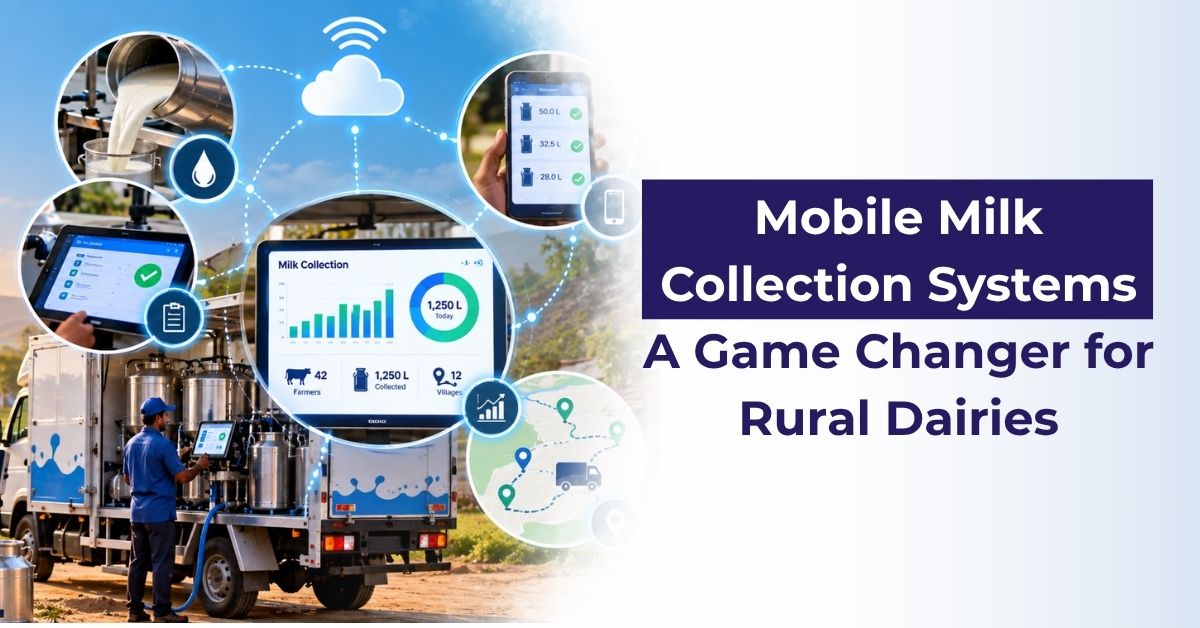
Mobile Milk Collection Systems: A Game Changer for Rural Dairies
For decades, India has championed milk production on a global scale, producing about 25% of the global milk. This comes from an intricate network of milk producers spread across some of the remotest villages. However, a significant share of this milk is lost or degraded before it reaches the processing plant, mainly because of poor cold-chain infrastructure at the first mile. For many dairy producers in remote villages, the challenge is not producing milk; it’s preserving milk quality before it reaches the chilling centre. This is where Mobile Milk Collection Systems can benefit both small- and large-scale milk producers by reducing travel time to deposit milk and preserving its quality.
Challenges Faced by Rural Milk Collection Networks
While India produces over 230 million metric tonnes of milk annually, there are consistent struggles with ensuring that the milk retains its quality from farm gate to the milk cooling equipment:
- Fixed village milk collection centres and bulk milk coolers are often far from remote villages, delaying chilling.
- Raw milk quality collected during warm weather tends to deteriorate rapidly.
- Fixed chilling infrastructure like a BMC demands a significant investment in terms of costs and manpower, which is not feasible for all villages.
These challenges often result in milk with a reduced shelf life and degraded quality – causing dissatisfaction among farmers, who often face quality rejections, and high procurement costs for dairies.
What Is a Mobile Milk Collection and Chilling System?
Portable milk cooling equipment has recently caught attention for its ability to increase efficiency across the cold chain. This system integrates milk testing, cooling, and transportation equipment all in one unit. Mobile milk chilling solutions like the Prompt MMCC include a larger vehicle with a bulk milk cooler, a milk quality testing apparatus, and a collection tank mounted on it.
The primary goal of this solution is to bring automated milk collection and chilling capacity to even the most remote villages, eliminating the need for fixed infrastructure.
Benefits of Mobile Milk Collection Systems for Rural Dairies
For milk collection establishments at the rural level, it is important that milk producers are not only able to deliver their milk on time; they must also have the apparatus necessary to chill raw milk with erratic power supply – a common sight in remote villages. Mobile milk chilling can address these challenges:
- It brings automated milk collection and chilling capability to remote villages, without the need for fixed infrastructure.
- Quality testing can be performed closer to the source, providing faster and more accurate assessment of FAT and SNF parameters.
- Payment is quality-based, fair, and incentivises better milk hygiene practices.
Solutions like the Prompt MMCC are also designed specifically for Indian rural dairy conditions, with particular attention to unreliable grid power, high ambient temperatures, and rugged terrain. They include a thermal storage system that charges the cooling medium at the dairy plant and uses that energy to chill milk on the go. The thermal storage system enables milk chilling even when grid power is unavailable, helping maintain cold-chain continuity in off-grid locations.
The Significance of Choosing the Right Chilling Solution
India’s cold-chain infrastructure is evolving, with new innovations emerging every day. For dairies, a mobile milk solution provides a great return on investment. The incoming raw milk already has better quality, with a lower bacterial count and lower acidity. It also eliminates the need to establish fixed chilling infrastructure and BMCs.
By integrating automated quality testing, weighing, pumping, and thermal-storage-based cooling into a single mobile unit, the MMCC system addresses the fundamental barriers of cost, logistics, and quality that have historically limited organised dairy procurement from remote villages.
Still pondering whether mobile milk collection is the right choice for your dairy? Connect with our experts.
FAQs
A Mobile Milk Collection System is a vehicle-mounted unit that combines milk collection, quality testing, chilling, and transportation into a single platform, enabling dairies to collect milk directly from remote villages.
By reducing the time between milking and chilling, mobile collection systems help limit bacterial growth and preserve milk freshness during transportation.
These systems bring collection and chilling infrastructure closer to farmers, reducing transportation challenges and improving access to organised dairy procurement.
Some systems use thermal energy storage technology, allowing milk chilling even in areas with inconsistent electricity supply.
They can help expand procurement reach, improve milk quality, reduce infrastructure requirements, and streamline collection operations.
