
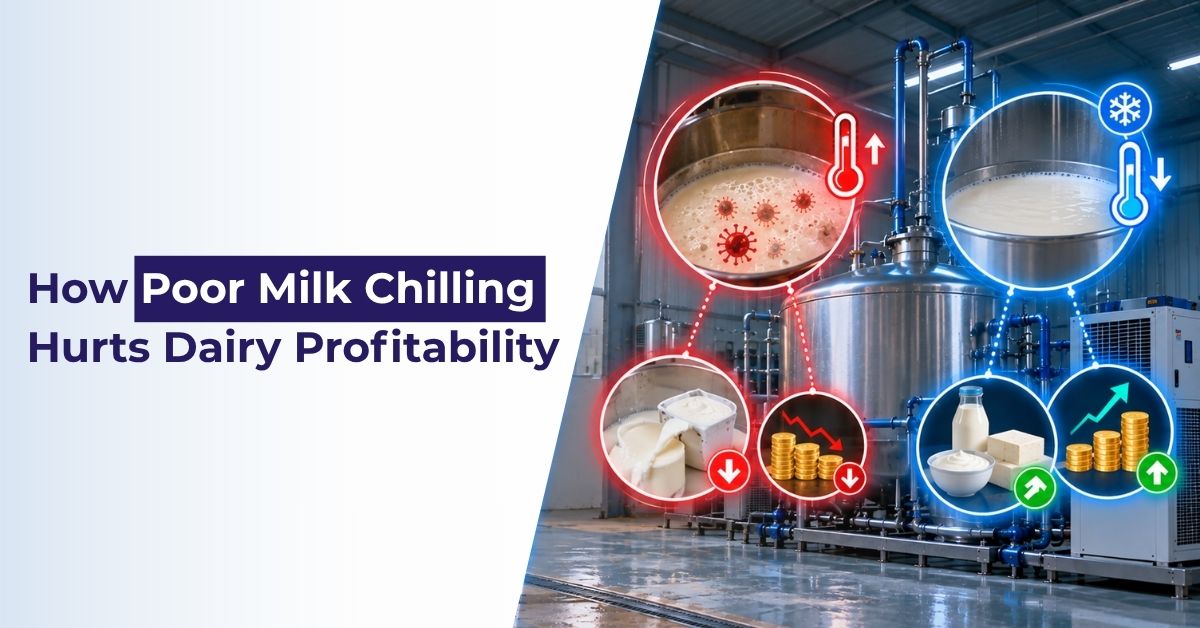
The Economic Impact of Poor Milk Chilling Practices
Milk is one of the most essential commodities in India – one of the global leaders in dairy production. But it faces a significant challenge.
Every litre of raw milk begins losing value the moment it leaves the cow. If milk is not cooled quickly enough, bacterial activity accelerates, reducing its shelf life, lowering its processing quality, and increasing the risk of rejection at the dairy plant.
For dairy cooperatives, poor milk chilling poses a direct economic challenge. The margin for error is slim.
Why Does Raw Milk Spoil So Quickly?
Freshly drawn milk is warm. If cooling is delayed, the warm temperatures form favourable conditions for bacteria to multiply.
The rate of spoilage is primarily influenced by:
Temperature: Raw milk starts at around 37°C, close to the cow’s body temperature. Unless it is chilled to 4°C within the first few hours, it is highly susceptible to spoilage.
Microbial Load: Initial exposure to bacteria, whether from poor hygiene or infected udders, can shorten the lifespan of raw milk.
As raw milk nears spoilage, it undergoes several biochemical changes that shift its colour, texture, and taste. If not cooled properly within the stipulated time period, spoilt raw milk could significantly impact a dairy’s operations.
Common Milk Chilling Mistakes That Reduce Quality
Even with chilling infrastructure, certain practices can compromise milk quality, its shelf life, and MBRT values – a common measure of quality used to check the bacterial load in a milk sample:
Delayed Cooling: The longer milk remains at elevated temperatures after collection, the faster bacterial growth occurs.
Temperature Fluctuations: Even if the milk is chilled within the required time, any temperature fluctuation in the cold chain increases the risk of spoilage.
Lack of Hygiene: If the cooling apparatus doesn’t undergo regular CIP and deep cleaning, the raw milk stored inside could become contaminated immediately.
Merely chilling raw milk doesn’t guarantee an increased shelf life for the raw milk. Unless it is immediately chilled, kept at a consistently low temperature, and stored in a clean chilling apparatus, it can still affect MBRT levels and the quality of the pasteurised milk.
The Economic Consequences of Poor Milk Chilling
The quality of the incoming raw milk is the biggest indicator of how it would fare post-processing. Milk that arrives warm with high bacterial load cannot be salvaged through pasteurization alone. But milk that is chilled poorly also impacts processors:
High rejection rates: Poorly chilled or spoilt milk has low MBRT values and a shorter shelf life. It often leads to the entire batch being rejected, where processors have to bear the loss.
Compromised milk products: Improper chilling affects not just the milk but also the quality of any product made from it. Such products would be produced in low quantities and be of low quality.
Increased processing costs: Poorly chilled milk enters the dairy plant with higher microbial activity and reduced quality. Although pasteurization can address microbial safety concerns, it cannot restore lost freshness or shelf-life potential. This can result in higher quality assurance costs, product losses, reduced shelf life, and lower returns from processed dairy products.
Therefore, raw milk requires appropriate chilling solutions that keep its quality, MBRT values, and freshness intact to avoid significant economic impact on milk producers and dairies.
Why Reliable Milk Chilling Matters
Maintaining milk quality requires more than simply installing cooling equipment. Collection centres must also account for operational challenges such as inconsistent power supply, long collection routes, and varying daily milk volumes.
The key takeaway from the above article is to find a chilling solution that focuses on keeping the quality of raw milk intact, enhancing its MBRT values, till it reaches the dairy plant for pasteurization.
In many rural regions, erratic power supply can make conventional cooling systems difficult to operate consistently. In such situations, solutions designed to maintain cooling performance during power outages can help protect milk quality and strengthen cold-chain reliability.
One example is the Prompt Thermal-based Storage Bulk Milk Cooler (TSBMC), which chills milk closer to the collection point, preserving quality and freshness. With a thermal storage system, it stores cooling energy when power is available and can use it when electricity is unavailable.
This enables collection centres to preserve milk quality, retain higher MBRT values, and deliver better-quality raw milk for processing.
In terms of economic benefits, field installations of solutions like the Prompt TSBMC have demonstrated milk souring reductions of 2-5% and price realisation improvements of up to ₹2 per litre. also reduces milk souring by 2-5%, offers higher price realisation by ₹2 per litre, and reduced energy costs due to its solar compatibility.
Poor milk chilling can quickly turn into an economic challenge that affects every stage of the dairy value chain. By investing in reliable chilling solutions and maintaining cold-chain integrity, dairies can protect milk quality, improve operational efficiency, and maximize the value of every litre collected.
Still wondering if your dairy needs a thermal-based cooling solution? Connect with our expert.
FAQs
Raw milk should typically be chilled and maintained at approximately 4°C to slow bacterial growth and preserve quality until processing.
Poor chilling accelerates bacterial growth, which can reduce MBRT values and indicate declining milk quality.
No. Pasteurization can reduce microbial contamination, but it cannot reverse quality deterioration caused by delayed cooling or prolonged bacterial activity.
Milk may be rejected when it fails quality requirements related to bacterial load, freshness, acidity, or other processing parameters.
Bulk milk coolers enable rapid chilling and temperature maintenance, helping preserve milk freshness, quality, and processing suitability.
