
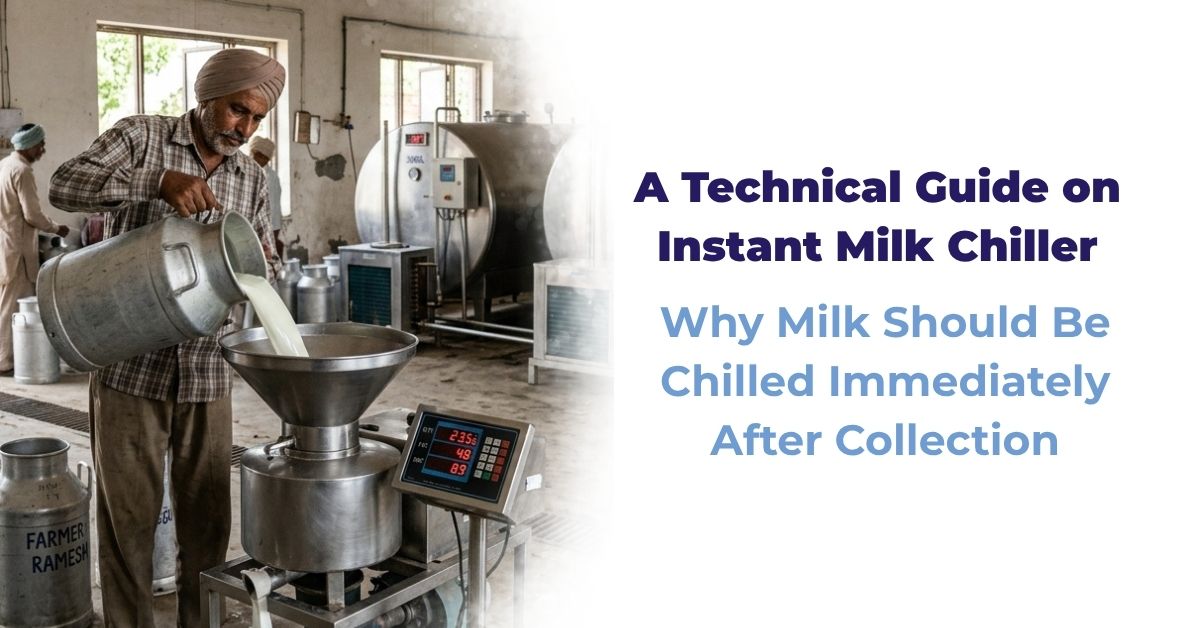
Why Milk Should Be Chilled Immediately After Collection: A Technical Guide on Instant Milk Chiller
A farmer rises before the break of dawn to collect fresh milk for consumers like us. However, before that milk can make its way to our doorsteps, it must embark on a lengthy journey—a journey that can be challenging for such a perishable product. So, how do we ensure that the milk we receive is both fresh and safe to drink?
The key is to utilize an instant milk chiller.
In this technical guide, we provide an overview of the typical dairy supply chain, the importance of quickly chilling raw milk, the science behind the process, the methods used, and the role of a milk chilling machine.
The Journey of Milk in India
Before fresh milk reaches your doorstep, it goes through several stages of safety checks and quality preservation.
The first step is obtaining the milk from the cattle. Farmers can have a few or several cows and/or buffaloes, depending on the scale of their farm. This milk is collected in cans and taken to a collection centre, where samples are tested for FAT, SNF, added water, density, and milk category (cow, buffalo, or mixed).
Depending on the distance from the collection centre, the milk is chilled in an instant milk chiller before being transported to the dairy plant.
Once at the plant, the milk is pasteurized and bagged, either for direct consumption or to prepare other dairy-based goods like ghee, yoghurt, and butter.
Why does Milk Spoil So Soon?
To understand milk preservation, we first need to give some background on this topic. Milk is primarily composed of water, along with fats, sugars, and protein. While rich in several nutrients, it also makes up an ideal breeding ground for bacteria to proliferate. The bacteria feed on these sugars and proteins, multiply rapidly, and contribute to spoilage.
This process worsens when the milk is kept at room temperature, where bacteria begin multiplying within the first hour. This is why drinking raw milk is risky, and time is of the essence when it comes to preserving milk’s quality.
What does Milk Spoilage Look Like?
Once microorganisms begin multiplying, they break down various components of the raw milk, producing undesirable compounds.
Lactose is converted into lactic acid, lowering the overall pH of the liquid and, consequently, turning it sour. Similarly, coliforms also produce various gases like CO2 that cause curdling.
Certain bacteria break down proteins and convert them into peptides and amino acids. This triggers putrid odours and leaves the milk tasting bitter.
Fats in the milk are also broken down, resulting in a rancid, soapy-tasting liquid.
These processes also change the milk’s texture and colour. Hence, preserving milk instantly is extremely crucial to render it safe for consumption.
The Science Behind Milk Chilling
Chilling milk slows the chemical changes that begin when it is harvested. The faster it is cooled, the more nutrients it retains. Generally, raw milk should be chilled rapidly to 4°C within an hour of being harvested. This stops microbial growth, improves quality, and helps extend the milk’s shelf life.
From rapid chilling to pasteurization, different stages of milk processing are crucial for eliminating different kinds of bacteria.
First step: Instant Chilling to 4°C
When raw milk is harvested, it remains at room temperature, which is ideal for mesophilic bacteria that grow anywhere between 20°C and 45°C. This group contains both organisms that contribute to souring, and dangerous pathogens. Instantly chilling the raw, freshly harvested milk to 4°C significantly suppresses their activity.
Second Step: Reducing Bacterial Load
Certain bacterial variants are not a primary concern in fresh raw milk. Thermophilic bacteria prefer high temperatures, typically between 45°C and 65°C, to proliferate. Rather than in the first few hours, these bacteria generally appear during the heat treatment process. However, chilling raw milk to 4°C immediately reduces the bacterial load. So while thermophilic bacteria may survive pasteurisation, a reduced bacterial load helps slow their growth at that stage.
Third step: Going beyond chilling
Rapid chilling bears the majority of the load and inhibits the growth of most bacterial variants. However, some variants, such as psychotropic bacteria, only thrive in cold environments. Therefore, simply chilling the raw milk isn’t enough to render it safe for consumption. Pasteurization, where milk is heated to about 71°C in India before rapidly cooling at around 10°C, is an important step that curbs these bacterial variants.
Throughout this process, instant milk chillers are in the spotlight for helping maintain the milk’s freshness. At Prompt, we offer the Thermal Storage-based Rapid Bulk Milk Cooler, a smart milk chilling machine for rapid cooling.
Traditional Cooling vs Instant Milk Chilling
| Parameter | Traditional Milk Cooling | Instant Milk Chiller |
|---|---|---|
|
Cooling Speed |
Gradual cooling over a longer period |
Rapid cooling immediately after collection |
|
Exposure to Bacterial Growth |
Higher due to delayed temperature reduction |
Lower due to quick temperature drop |
|
Milk Quality Retention |
Moderate |
High |
|
Spoilage Risk |
Higher |
Significantly lower |
|
Shelf Life Preservation |
Limited |
Improved |
|
Dependence on Continuous Power |
High |
Can be reduced with thermal storage solutions |
|
Suitability for Remote Locations |
Challenging |
Well-suited for rural and off-grid areas |
|
Operational Efficiency |
Moderate |
Higher due to faster cooling and better quality preservation |
Instant milk chillers rapidly reduce milk temperature after collection, minimizing the time milk remains in the bacterial growth zone. Studies comparing conventional bulk milk cooling with instant milk chilling have shown that milk remains exposed to temperatures above 10°C for a significantly shorter duration when instant chilling is used, helping preserve freshness and quality.
How Does Prompt’s Milk Chilling Machine – The Thermal Storage-based Bulk Milk Cooler (TSBMC) Work?
In India, nearly 5-10% of the millions of litres of collected milk are lost to heat, power cuts, and poor cooling. Traditional bulk milk coolers often depend on diesel generators or the power grid; the former is costly and unsustainable, while the latter is unreliable. They are also often slow, delaying the critical temperature drop needed to safeguard milk quality.
Here’s where the Thermal Storage-based Bulk Milk Cooler, an instant milk chiller, hits two birds with a single stone. It stores cooling energy when electricity is available, and then utilizes that energy to cool milk during power failures. It also integrates with solar or hybrid power systems, enabling sustainable milk chilling.
It combines thermal energy storage, solar compatibility, and smart control to provide seamless cooling. The system continues to cool milk even if power isn’t available, while also ensuring the milk chills to 4°C within two hours.
It single-handedly solves for:
- Unreliable power supply
- Diesel dependency
- Slow cooling time
- High maintenance costs
- Lack of sustainable options
Instant Milk Chiller at a Glance
The dairy supply chain, while not as complex, is quite meticulous and time-bound. Every minute matters when the goal is to preserve milk quality, and with every hour that passes, room-temperature raw milk becomes more susceptible to bacterial growth.
An instant milk chilling machine like the Prompt TSBMC is a key part of the supply chain, using sustainable resources to chill milk to recommended temperatures instantly.
Want to improve milk quality and reduce spoilage losses?
Connect with our dairy cooling experts to learn how the TSBMC can support your milk collection and preservation needs.
FAQs
A Bulk Milk Cooler is a refrigeration system designed to rapidly cool and store milk after collection.
Rapid cooling in a milk chilling machine slows microbial activity, preserves milk quality, and helps extend shelf life until the milk can be processed.
Raw milk should ideally be cooled to 4°C as quickly as possible after collection.
Spoiled milk may develop a sour smell and taste, curdling or coagulation, bitter or rancid flavours, changes in texture and appearance, and an unpleasant odours caused by bacterial activity.
India’s warm temperatures accelerate bacterial growth in raw milk, hence it needs to be cooled instantly.
At room temperature, bacteria can begin multiplying within the first hour after milking.
